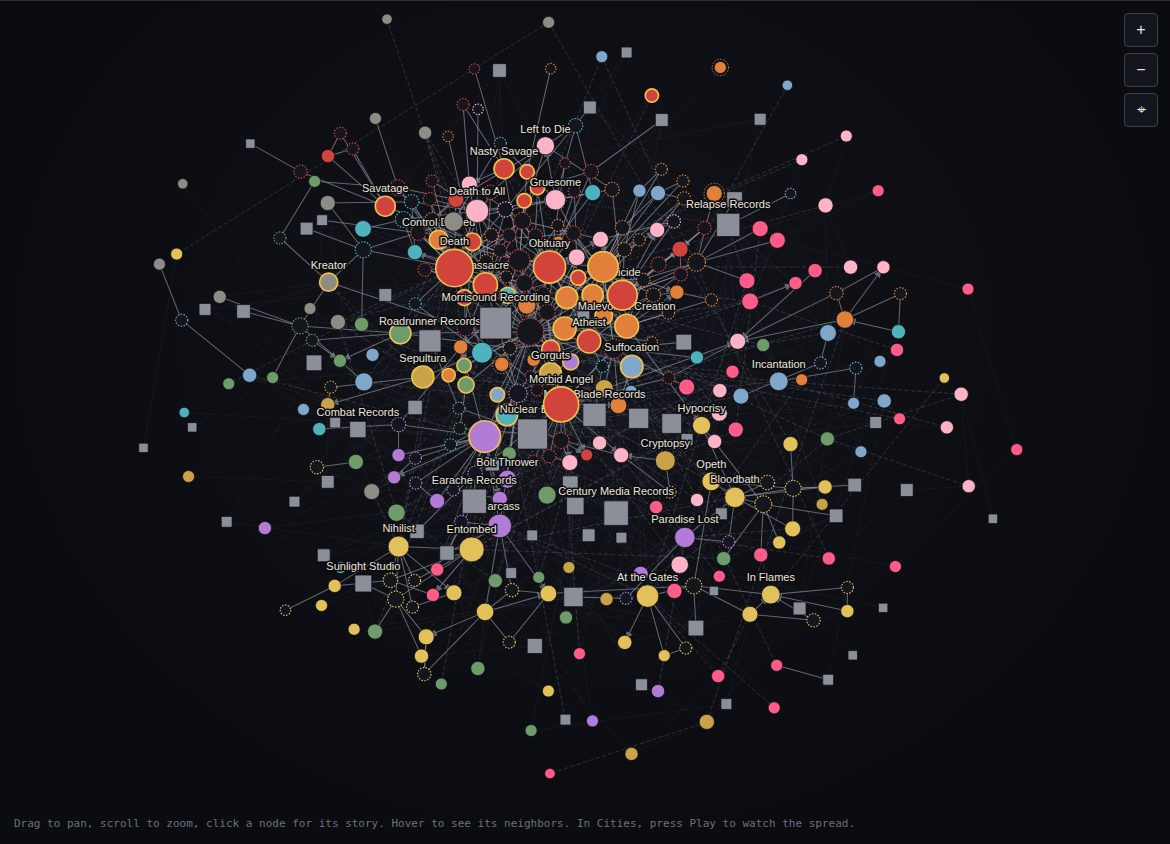
How to read this map
Every circle is a band, every dashed circle a person who carries, anchors, connects or produces a band, every square an institution: a studio, a label, a festival, a venue, a magazine, a network. Colour is lineage. Amber rings mark bands with a verified album tracked at Morrisound Recording. Node size follows how connected a node is, so the hubs of the scene stand out on their own.
Lineage lays the scene out on a timeline, left to right by founding year, with each lineage in its own lane. Network lets the connections pull the map into clusters, which is where you see who really sits at the centre. Cities puts everything on a world map, clustered around its hometown, because a scene is a place before it is a genre. The amber pin is a hub’s true location; hubs slide apart where Florida and northern Europe get crowded. Florida nodes without a recorded city sit in the Gulf, and touring projects with no home sit in the Atlantic. 3D is the network in three dimensions: the same nodes, connections, filters, cases and panel, drawn with WebGL. Drag to orbit, scroll to zoom, right drag to pan, click a node to fly to it and open its story.
Play runs the timeline as an animation from 1979 to 2026 in whichever view you are in. In Cities it is the spread itself: Tampa first, then the studio lines and personnel lines reaching Buffalo, New York, California, Sweden, Britain, the Netherlands, Germany, Brazil and Quebec. Pause it anywhere and the year slider stays where it stopped. A band or institution enters at its founding year and a person at their first documented activity. A node with no recorded founding year enters at the first year the map documents it, never earlier, and its panel says so under Placed at; a node with no dated link at all enters at the cutoff year. Influence relations never date a node.
Solid lines are people and bands moving: members, founders, one band spawning another, a producer's credit. Dashed lines are influence, used only where the descendants have said it themselves. Dotted lines are recording credits, labels, festival appearances and tours. Click any node and the panel on the right tells its story and lists every connection; Trace lineage lights up everything upstream and downstream of it.
Scope and rules. The map covers death metal as a scene that began in Tampa Bay and the places it reached, 1979 to 2026: the Florida origin and its precursors, the studio at its centre, the labels that came to it, the bands that flew in to record, the scenes that answered it in Stockholm, Gothenburg, the English Midlands, the Netherlands, Germany, Poland, Brazil and Quebec, the genres downstream of it, and the revival of the 2010s and 2020s. A node is on the map when it has a documented personnel, spawning, recording, label, festival or declared influence link to at least one other node. A band is linked to a studio only when a specific album and year are recorded for it; several widely repeated Morrisound credits are wrong and are placed at the studio where the album was in fact made. A person appears when they make a material connection legible: the guitarist who leaves one band and founds another, the drummer who plays in three projects, the producer whose credit connects a label to a room, the A and R man who signs the roster. Each person carries a relationship class in the panel: personnel connector (moved between two or more mapped bands), founding or core member, institutional connector, or guest support performer. Guest support is never counted as membership in the personnel only graph. Hub region is the place of formation, or the home base a band states for itself, folded into a metro hub: Tampa Bay includes Brandon, Temple Terrace, Ybor City, Clearwater, St. Petersburg, Tarpon Springs, Gibsonton and Sarasota; Orlando includes Altamonte Springs and Sanford; Miami and Fort Lauderdale are one hub; New York includes Long Island, Yonkers, the Bronx, New Jersey and Rhode Island; the English Midlands and North include Birmingham, Coventry, Nottingham, Liverpool, Telford and the Yorkshire towns; the Ruhr includes Essen, Gelsenkirchen, Dortmund, Hagen and Meschede. A band that relocated sits at its Florida home, with its origin recorded in its city field, so Cannibal Corpse and Malevolent Creation count for Florida and their Buffalo feeder bands count for Buffalo. Every count by place uses that hub. The Morrisound flag: tracked means at least one full album was tracked at the studio; partial means a record was mixed or mastered there only, or is a Scott Burns production made elsewhere.
Current cases. Morrisound Recording, Scott Burns, Cannibal Corpse, Death, Sepultura, Studio Fredman and Gruesome are singled out in the sidebar because each illuminates a different mechanism by which a scene becomes a genre: the room that made the place; the transmission system; inbound relocation; the personnel engine; the fly in client that carried the sound home; the place that answered with its own studio and its own genre; and export by record rather than by people. A case is featured only when it rests on at least one official studio, label, artist or festival source, an independent source for any historical or superlative claim, a date, a defined relationship or event, a separation of completed from announced activity, and no reliance on private communications. Node size and centrality are computed from the dataset and are never adjusted for a case.
Evidence. Data are current through . Activity after that date is described as announced or scheduled, never as completed. Each node carries a confidence grade and source ids in its panel: High means an official, book or scholarly source, or three sources including press; Medium means Wikipedia, Metal Archives or a single press report; Low means a detail still flagged as unverified. Connection counts and betweenness are computed on this dataset, with every edge type weighted equally, and describe position in the map, not popularity or sales.
Downloads: PDF reference · Node and edge dataset (Excel) · data.json · Japanese Metal Family Tree